FDM vs SLA 3D Printing Understanding the Key Differences
3D printing has transformed product development, manufacturing, and prototyping across industries. Among the many additive manufacturing technologies available today, FDM (Fused Deposition Modeling) and SLA (Stereolithography) are two of the most widely used methods.
Both technologies create three-dimensional objects layer by layer, but they use completely different processes, materials, and applications.
Understanding the difference between FDM and SLA 3D printing technologies helps engineers, designers, and manufacturers choose the right solution for their needs
What is FDM 3D Printing?
FDM (Fused Deposition Modeling) is one of the most popular and widely used 3D printing technologies. It works by melting thermoplastic filament and depositing it layer by layer to create a physical object.
The printer extrudes heated filament through a nozzle and follows a digital CAD design to build the object from the bottom up.
FDM printers are commonly used for:
• Product prototyping
• Industrial manufacturing
• Engineering testing
• Educational projects
• Functional parts production
Many industrial machines like the Pratham series from Make3D use FDM technology because it offers strong parts and reliable manufacturing capability.
What is SLA 3D Printing?
SLA (Stereolithography) is a resin-based 3D printing technology that uses a UV laser to cure liquid photopolymer resin into solid plastic layers.
Instead of extruding melted plastic like FDM, SLA printers use a laser to selectively harden resin inside a resin vat.
SLA printing is known for producing extremely detailed and smooth parts, making it ideal for precision applications.
SLA printing is commonly used for:
• Jewelry casting models
• Dental models
• Miniature models
• Product design prototypes
• Medical components
Key Differences Between FDM and SLA 3D Printing
1. Printing Process
FDM Printing
Uses melted thermoplastic filament extruded through a heated nozzle.
SLA Printing
Uses a UV laser to cure liquid resin layer by layer.
2. Materials Used
FDM Materials
PLA, ABS, PETG, Nylon, Carbon fiber composites
SLA Materials
Photopolymer resin, Castable resin, Dental resin, Engineering resin
FDM materials are generally stronger and more suitable for functional parts.
3. Print Quality
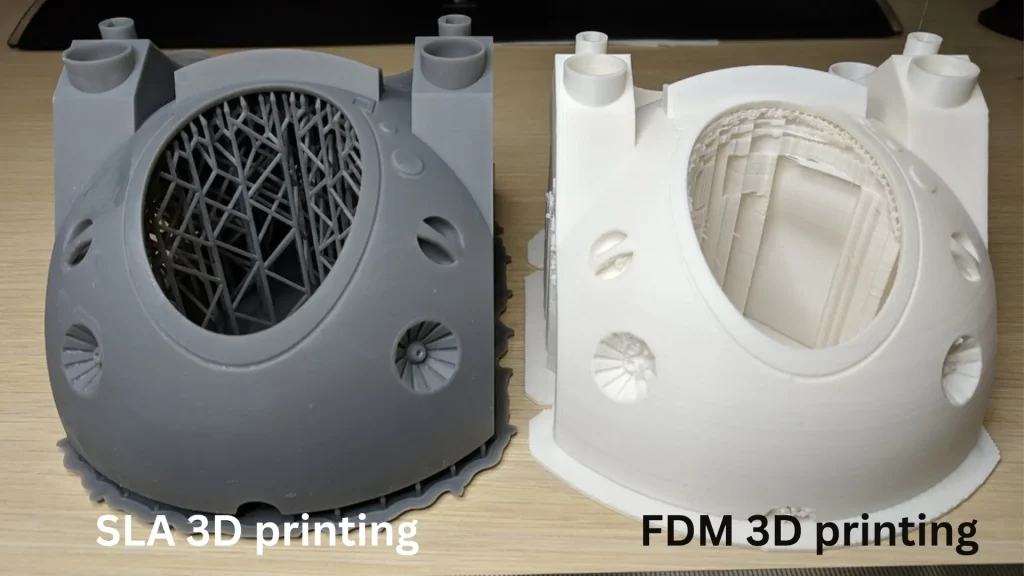
SLA printers produce higher resolution prints with smooth surfaces, making them suitable for detailed models.
FDM printers produce slightly visible layer lines but offer stronger mechanical parts for engineering applications.
4. Strength of Printed Parts
FDM printed parts are generally stronger and more durable because thermoplastics have better mechanical properties.
SLA prints are more brittle but offer excellent detail.
5. Cost of Printing
FDM printing is usually more cost-effective because filament materials are cheaper and printers require less post-processing.
SLA printing involves higher material costs and additional post-processing steps such as washing and UV curing.
When to Choose FDM 3D Printing
FDM printing is ideal for:
Engineering prototypes, Functional parts, Manufacturing tooling, Large scale prints, Industrial applications
Industrial printers such as Make3D Pratham series are designed specifically for these applications.
Example machines: Pratham Desktop , Pratham 3 Rapid , Pratham X Jumbo
When to Choose SLA 3D Printing
SLA printing is best suited for applications that require extremely fine details.
These include: Jewelry casting patterns, Dental molds, Miniatures, Product concept models, Medical applications
Future of FDM and SLA Technologies
Both FDM and SLA technologies are evolving rapidly. Industrial FDM printers are becoming faster and capable of printing high-performance engineering materials.
At the same time, SLA technology is advancing with new high-resolution resins and automated workflows.
As industries adopt additive manufacturing, these technologies will continue to play a key role in product development, manufacturing, and design innovation.
Conclusion
Both FDM and SLA 3D printing technologies offer unique advantages depending on the application.
FDM printing is best suited for functional prototypes, industrial parts, and large-scale manufacturing, while SLA printing excels in high-precision models and detailed designs.
By understanding their differences, businesses and engineers can select the right technology for their projects and maximize the benefits of additive manufacturing.