
Best 3D Printing Techniques for Consumer Goods
Walk into any electronics store, furniture showroom or sports equipment outlet and chances are that at least one product on the shelf has been influenced by 3D printing during its development.
While headlines often portray 3D printing as a replacement for traditional manufacturing, the reality is more practical. In the consumer goods industry, additive manufacturing is primarily used to reduce development time, validate designs earlier and solve manufacturing challenges before production begins.
The question isn’t “Which technology is the best?” It’s “Which technology is best for this particular application?”
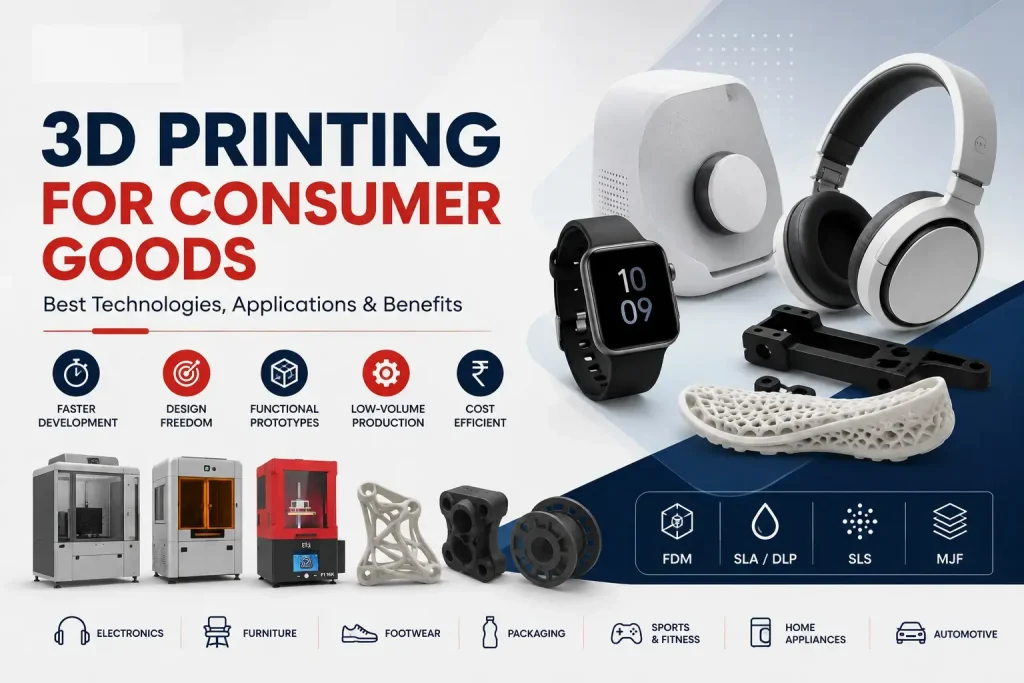
Not Every Product Needs the Same 3D Printing Process
A cosmetic packaging prototype demands a flawless surface finish. A vacuum cleaner bracket must withstand repeated use. A smartwatch strap needs flexibility, while a customized kitchen accessory may require fast, low-cost production.
Using the same printing technology for all these applications would simply be inefficient.
That’s why successful product development teams select the printing process based on the purpose of the part; not just the machine available.
FDM When Function Matters More Than Appearance
If a design team wants to check whether a newly designed blender handle feels comfortable to hold or whether an enclosure fits all internal components correctly, they don’t need a mirror-like finish. They need a reliable functional prototype quickly and economically.
This is where FDM is often the first choice.
Its strength, material versatility and lower operating cost make it ideal for engineering validation, assembly checks, fixture development and early-stage product iterations.
A good example is Dyson’s cordless vacuum cleaner range. Developing products that are lightweight, durable, and comfortable to use requires extensive design validation. By producing multiple prototype iterations using technologies like FDM, engineers can evaluate grip, assembly, and internal layouts long before committing to injection moulds, reducing both technical risk and development cost.
SLA and DLP: Visual Validation
Some products are judged long before they are manufactured.
Consider a premium cosmetic bottle, a consumer electronic device or a luxury home appliance. Investors, marketing teams and customers often see the prototype before production begins.
In these situations, surface quality becomes part of the decision-making process.
- The wireless earbud market offers a great example. Compare the charging cases from Apple AirPods, Samsung Galaxy Buds, Sony WF Series, Nothing Ear, or boAt each has a unique size, opening mechanism, and ergonomic design.
These differences aren’t accidental; they’re refined through multiple prototype iterations. SLA and DLP allow designers to create realistic models that help evaluate aesthetics, usability, and overall user experience before committing to production tooling.
SLS and MJF: When Prototypes Start Behaving Like Final Products
Eventually, companies need to move beyond appearance and evaluate real-world performance.
Can the snap-fit survive repeated assembly?
Will the enclosure handle daily use?
Does the wearable component maintain its strength over time?
This is where SLS and MJF become valuable.
These powder-based technologies produce durable components without the support structures required by many other processes. They are widely used for functional testing, pilot production and low-volume manufacturing where the printed part is expected to perform much like the final product.
Consider the adjustable armrest of an office chair. Every click, slide, and height adjustment puts stress on the internal components. Before production begins, manufacturers need to know whether these parts will continue performing after thousands of adjustment cycles. SLS and MJF allow engineers to test these real-world conditions using durable functional prototypes.
So, Which Technology Should You Choose?
Rather than asking which technology is superior, it helps to start with the product requirement.
If your priority is… | A practical choice |
Fast and affordable design iterations | FDM |
Premium appearance and fine details | SLA or DLP |
Strong functional testing | SLS |
Low-volume production with consistent quality | MJF |
The right technology is the one that answers your engineering question with the least cost, time and complexity.
The Bigger Picture
One common misconception is that 3D printing is only useful for prototypes.
Reality tells a different story.
- Adidas 4D running shoes feature 3D-printed lattice midsoles, manufactured for commercial sale rather than prototyping.
- Nearly all custom hearing aids are now produced using 3D printing, enabling a personalised fit for every individual.
- Invisalign clear aligners rely on 3D printing during the manufacturing process to create millions of patient-specific dental models every year.
These examples show that additive manufacturing has moved well beyond product development.
Instead of replacing conventional manufacturing, it complements it delivering customization, design freedom, and production flexibility where traditional methods fall short.
Where Make3D Fits into This Journey
At Make3D, conversations with product designers and manufacturing teams rarely begin with “Which printer should we buy?”
They usually begin with questions like:
- How quickly can we validate this design?
- Can we reduce tooling iterations?
- Which process makes sense for our application?
Sometimes the answer is FDM. Sometimes it’s resin printing. In other cases, it may be more practical to use industrial 3D printing services before investing in equipment.
Choosing the right process is often more important than choosing the most advanced machine and that’s the mindset that leads to better engineering decisions.
Final Thoughts
The true value of 3D printing is defined by choosing the right process for the right stage of product development.
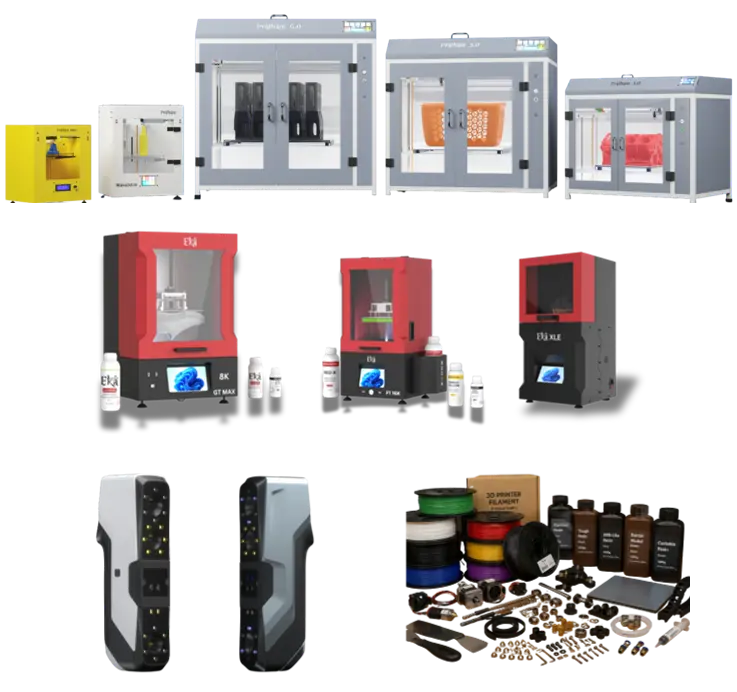
At Make3D, this philosophy drives everything we do. From the Pratham Series of industrial FDM 3D printers for functional prototypes, the EKA Series of resin 3D printers for high-detail models, 3DeVOK professional 3D scanners for reverse engineering and inspection, to ZRapid SLA systems for precision
applications, every solution is designed to address a specific engineering requirement rather than follow a one-size-fits-all approach.
Beyond our product portfolio, our in-house additive manufacturing facility with 50+ industrial machines enables us to support customers with rapid prototyping, reverse engineering, product development, functional testing, and low-volume production across a wide range of industries.
Whether you’re building the next consumer product or improving an existing one, the goal remains the same: apply the right technology at the right time. That’s how innovative ideas become reliable, market-ready products.
Frequently Asked Questions (FAQs)
1. Which 3D printing technology is best for consumer products?
FDM is excellent for functional prototypes, while SLA and DLP are ideal for high-detail visual models. For durable end-use products and batch production, SLS and MJF are the preferred choices.
2. Can 3D printing be used for mass production of consumer goods?
While traditional manufacturing remains more economical for very high volumes, technologies like MJF and SLS are well-suited for low- to medium-volume production and customized consumer products.
3. What materials are commonly used for consumer goods?
Common materials include PLA, ABS, PETG, Nylon, TPU, engineering-grade resins and powder-based materials such as PA12 and PA11.
4. How does 3D printing reduce product development time?
It enables rapid prototyping, allowing designers to quickly test, refine and validate designs without waiting for molds or tooling, significantly shortening the product development cycle.
5. How can Make3D help consumer goods manufacturers?
Make3D provides industrial 3D printers, professional printing services, reverse engineering, product design support and rapid prototyping solutions to help businesses develop and launch innovative consumer products more efficiently.
